
Introduction: Scene and Setting
I had stopped trusting myself
Letting the numbers drown out
My intuition
My instincts
I was afraid
Of not being in control
Of becoming obese like my genetic predecessors
I was addicted
To my iPhone apps
To getting the right numbers
To beating myself up
– Alexandra Carmichael, Why I Stopped Tracking, 2010
In 2010, long time Quantified Selfer Alexandra Carmicheal posted her poem "Why I Stopped Tracking" online. Part litany, part declaration—the poem weaves fear, addiction, self-punishment, and the burdens of genetic inheritance, into a startling picture of the costs of self-tracking when it becomes the guiding measure of embodied life. Carmicheal presciently describes the mounting concerns of offloading our sensorial and interpretive capacities, which have only accelerated with the advent of large language models (LLMs) and generative artificial intelligence (GenAI). The practice of quantifying every aspect of her life to remove the “guess work” of intuition to improve her health had, for Carmicheal, engendered a costly disconnect with her embodied reality: one in which her felt contact with her instincts became muted by the symbolic power and control of numbers (Wolf 2010; Nafus and Neff 2016).
Since the poem’s publication, concerns regarding the deleterious ability of wearables to undermine trust in one’s body—or even induce a form of health anxiety or ‘addiction’—have proliferated across the media. Fellow users of wearable technologies decry their dependence on readiness and sleep scores, positioning them as the active arm of the “self-control industrial complex” (Inzlicht 2025). Oura rings morph from data-rich health companions to panoptic “cops on a finger,” feedback registers as a “freakback”, prompting Madison Kircher (2025) to recently ask for the New York Times: “Is all this self-monitoring making us paranoid?” (Marrison 2025; Smith and Vonthethoff 2016). And yet, for every charge of dependence and disconnection, neoliberal surveillance and self-optimisation, there is an equal quorum of adopters who believe wearables are indispensable tools for gaining insight into their health—devices that elevate previously ineffable experiences like rest and recovery into actionable metrics (Nafus and Neff 2016; Lupton 2014; Schüll 2019).
The tensions between insight and overreliance, care and control are not easily resolved. They reveal deeper cultural anxieties about the role of technology in shaping our sense of self, agency, and embodiment. Wearable technologies and AI are not simply tools of measurement; they are reconfiguring how we think about effort, self-understanding, and the very process of knowing. AI has brought cognitive offloading—the way we outsource mental tasks to machines—into view. But wearables introduce a subtler concern of somatic offloading—the delegation of bodily awareness, interpretation, and regulation to external data representations. If cognitive offloading raises fears of losing our mental edge (our creativity, memory, and reasoning), somatic offloading evokes a more intimate worry that we might lose touch with our own felt sense. The fear, in both cases, is that emerging technologies erode the very human capacities through which we orient ourselves in the world. And in some ways, that fear is warranted.
The task at hand, then, is not simply to take sides in the cultural debate that frames wearables as either “formidable [or] inept,” but rather to take seriously the lived experiences of users by examining how and when wearables support or hinder bodily awareness (Grinberg 2025). By introducing somatic offloading as a guiding concept, our research investigates how wearable technologies can be designed to reengage, rather than replace, the user’s connection to their own body. Through ethnographic interviews with wearable users experienced in somatic practices and professional somatic practitioners, our research aims to chart a middle path—one that:
-
Dignifies and designs for the somatic intelligence of users
-
Leverages data and composite health scores (CHS) not to override felt experience, but to illuminate moments to which awareness, interpretation, or regulation might be reattuned
-
Provides scaffolding to help users engage with imperfect or ambiguous data in ways that build, rather than undermine, trust in their own bodily knowing.
In this way, we argue that users can preserve the kind of somatic sovereignty that individuals like Carmichael, and many others, yearn for. We show how wearables can serve not as replacements for bodily awareness, but as dialogic partners in the ongoing sensing and regulation of internal states.
Our paper unfolds in three movements. First, we synthesize core insights from cognitive offloading, interoception science, and somatic psychology to articulate a working definition of somatic offloading that guides our analysis. Second, we turn to ethnographic interviews to examine how somatic practitioners support clients in cultivating interoceptive attention, and how experienced wearable users with high somatic literacy navigate the tensions between data and direct sensation. We focus especially on three interwoven processes of bodily awareness:
-
Sensing: Noticing internal bodily signals, such as tension, heat, fluttering, or stillness, without immediately interpreting them.
-
Sense-making: Making meaning from those sensations by connecting them to emotions, memories, metaphors, or narratives.
-
Tending: Responding with an embodied action from what’s been sensed and made meaningful.
Lastly, we propose design principles for ‘soma-centric’ wearables—framed by the opportunities and risks of GenAI—that reimagine devices not as prescriptive authorities but as dialogic partners that scaffold bodily attention. Our intention here is to both support innovation in design and to equip ethnographic researchers with a more granular lens, which moves beyond the typical focus on usability, pain points, and user needs to illuminate what is often vaguely described as “bodily intuition” or “the mind-body connection” (Smith and Vonthethoff 2017). By reframing offloading not as a failure, but as a relational phenomenon with multiple trajectories, we invite a more complex, more compassionate inquiry into how we can live, design, and relate with our technologies rather than despite them.
Movement I: Understanding Somatic Offloading
The Vagaries of Offloading
Cognitive offloading, in essence, describes the human tendency to delegate mental effort to external resources (Clark and Chalmers 1998; Risko and Gilbert 2016). Examples of offloading range from simple notetaking and navigation to computational outsourcing, all of which enhance cognitive efficiency by freeing up limited working memory (Sweller 1988). While seemingly benign at its face, offloading is now inescapably intertwined with AI’s capacity to automate complex cognitive functions, raising concerns regarding the long-term consequences of “cognitive debt”, which de-skills individuals over time (Kosmyna et al. 2023).
Central to this process is metacognition—our awareness of how we think. This often shows up as a “feeling-of-knowing” (FOK), where we intuitively sense that we know something even if we can’t recall it (Irak et al. 2019). This effect, familiar in the age of Google search, has a somatic parallel (Carr 2010). When we offload bodily tracking to a wearable, we may not lose awareness entirely, but we shift its locus—from directly sensing ‘my heart feels fast’ to checking if our readiness score confirms it. The data becomes the confirmation of the user’s reality, even when a sensation preceded it.
This sets the stage for what we call somatic offloading: the process by which individuals externalize the detection, interpretation, and regulation of their internal states to devices. To better understand this shift, we turn to interoception, the physiological basis of internal awareness (Craig 2002; Khalsa et al. 2018). Interoception refers to how the nervous system senses, interprets, and integrates internal bodily signals, producing a moment-by-moment map of how we feel, often beneath conscious awareness (Farb et al. 2015). These signals (heartbeat, breath, temperature, and gut sensations) shape our internal sense of emotional and bodily states and work together with exteroception (the perception of the external world through sight, sound, and touch) to help regulate behavior, assess safety, and create a coherent sense of self-in-the-world (Price and Hooven 2018).
Crucially, research shows that interoceptive awareness is not fixed and can be trained over time; yet wearables may unintentionally undermine its cultivation (Foerster 2024). In interviews with athletes, Boldi and Rapp (2022) found that habitual reliance on wearable feedback dulled their ability to ‘run by feel,’ leading to misjudgment of effort and performance. The implication is not that self-tracking is solely negative, but that it reconfigures the awareness of our somatic baseline. More broadly, interoceptive abilities vary by sex, neurodivergence, trauma history, and context, suggesting that no single metric can capture what ‘optimal’ interoception looks like (Alfano et al. 2023; Garfinkel et al. 2015; Bonaz et al. 2021). Afterall, awareness is highly contextual, never absolute.
Here, then, we define somatic offloading as the gradual shift in which individuals delegate their interoceptive processes—sensing, interpreting, and tending—to external systems. The wearable becomes not just a data logger, but a technological prosthesis or “exo-sense” for bodily feeling (Nafus and Neff 2016; Lupton 2014). While these exosenses can surface subtle patterns, they can also induce somatic debt: the diminishing of interoceptive trust due to habitual reliance on metrics. Over time, users may no longer consult their feelings, but instead turn to their dashboards.
Research indicates this is not a theoretical risk. Studies on heart rate monitors and sleep trackers show that persistent tracking can increase anxiety, preoccupation with symptoms, and even result in orthosomnia—a condition where the pursuit of perfect sleep undermines sleep itself (Baron et al. 2017; Jahrami et al. 2024; Rosman et al. 2024). For Lupton (2014), this kind of reliance is engendered by the device itself. In such cases, somatic offloading is the mechanism through which metrics, categories, and visualisations embedded within wearables, supplant users’ personal feelings and felt sense, rendering their body captured by the data it produces. But somatic offloading need not lead to disconnection. The missing piece, we argue, is not just better data or recommendations, but a deeper grounding in somatic practice.
Somatics and the Practice of Self-understanding
With all the numberless goings-on of life,
Inaudible as dreams! the thin blue flame
Lies on my low-burnt fire, and quivers not
— Samuel Taylor Coleridge, Frost at Midnight, 1798
The practice of somatic self-understanding—like Coleridge’s flickering flame—is often subtle, difficult to grasp, and nearly impossible to fully quantify. Indeed, interoception itself is notoriously hard to measure. While tools like the MAIA scale (Multidimensional Assessment of Interoceptive Awareness) offer self-report methods, and heartbeat detection remains the gold standard in experimental settings, both have serious limitations, including recall bias and narrow operational definitions (Mehling et al. 2018).
By contrast, somatic psychology has long cultivated a framework for understanding interoception outside the language of metrics. Rooted in practices like breathwork, body scanning, and therapeutic movement, somatic psychology views the body not just as a source of data, but as a site of knowing (Ogden and Minton 2000; Mehling et al. 2011). Its practitioners center direct, felt experience over interpretive analysis, challenging the Cartesian divide that renders the body object rather than subject (Gendlin 1982). This orientation aligns closely with anthropological theories of embodiment that position the lived body as the “existential ground of being” (Csordas 1990). Somatic practitioners work directly with this terrain, helping clients tune into the textures and temperatures of sensation—what is fast or slow, sharp or diffuse, hot or cool, rising or settling—never to define, fix, or eliminate, but rather to better relate and respond to what arises in the moment.
One particularly rich lineage here is Formative Psychology, developed by Stanley Keleman (1989). Following his dictum of “form yourself or be formed by others,” Keleman views life as a continuous process of bodily shaping, where inherited muscular-emotional patterns can be differentiated and altered through voluntary muscular-cortical effort (Eichhorn 2014; Keleman 1989). His method of intensity gradients invites individuals to incrementally contract and release muscles, such as forming and softening a fist, to explore the spectrum of bodily intensity. This process helps individuals parse previously undifferentiated states with greater specificity as what feels like ‘anxiety’ might, in fact, be alertness, excitement, or even anticipation.
Levine’s (1997) theory of Somatic Experiencing adds an emphasis on safety and co-regulation as preconditions for bodily healing. Practices such as pendulation train individuals to oscillate between distress (the “trauma vortex”) and embodied resources of safety (the “healing vortex”), often anchored in memories of trust or belonging (Levine 1997, 198–200). This dynamic builds nervous system flexibility while protecting against retraumatization. Polyvagal Theory deepens this understanding by situating safety within the social nervous system (Porges 2009); emotional regulation emerges not only through self-awareness, but through cues of trust, care, and attunement with others. Both theories highlight the ‘freeze’ or immobilization response—a subtle but pervasive bodily pattern—as a key factor in how people react to discomfort and distress.
In doing so, somatic practices echo Ruckenstein and Pantzar’s (2017) concept of the Qualified Self—shaped not by abstracted metrics alone, but by situated, reflective interpretation. Where the Quantified Self seeks knowledge through numbers, the Qualified Self seeks understanding through context, nuance, and meaning. As Boam and Webb (2014) describe, the Qualified Self allows us to better “understand the quality of these quantities, and thereby better understand our being” (2016, as cited in Lupton, 110). As this capacity grows, they suggest, “the emphasis shifts to more metaphysical ways of describing ourselves.” Somatic practice trains this quality by building a tolerance for ambiguity and cultivating discernment rather than diagnosis.
These practices don’t eliminate the value of wearable data—they prepare the user to meet it with nuance. When somatic practitioners or experienced users engage with wearables, they don’t treat metrics as absolute truths. Instead, they might ask: What does this score feel like in my body? What do I know that the device does not? Can this tension between my felt sense and scores be a space of learning rather than anxiety or fear? In the next movement, we turn to our ethnographic interviews to both explore how this relational intelligence shows up in practice and the ways wearables can either support or disrupt the delicate dance between tracking sensations and scores.
Movement II: Navigating Human-Wearable Entanglements
This study employed a qualitative, ethnographically informed approach to explore how individuals integrate somatic practices and wearable technologies in cultivating interoceptive awareness. Our focus was on how users navigate between bodily sensation and algorithmic interpretation—what we call bottom-up (felt-first) and top-down (data-led) approaches to self-understanding.
We conducted semi-structured interviews with nine participants across the UK, France, and the US. Five were regular wearable users (Oura, Polar, WHOOP, Fitbit) who also maintained somatic practices, and four were licensed somatic psychotherapists. All participants who were wearable users in our study identified as women. Our selection here was intentional. Scholars such as Caroline Criado Perez (2019) highlight how women have historically been under-researched in the development of wearable devices and excluded from biomedical research more broadly. Only recently have companies like WHOOP and Oura introduced features enabling women to track menstrual cycles and hormonal fluctuations (Meserve 2025; Kryder 2023).
Recruitment followed a snowball sampling approach, and all participants gave informed consent. Interviews lasted about 60 minutes and were conducted remotely, allowing us to observe how tone, rhythm, and language shape body-based guidance in online therapeutic settings, which have become common since the pandemic. Practitioner interviews included short, guided exercises to simulate the delivery of somatic techniques. This helped us analyze how embodied real-time guidance differs from the prescriptive cues often issued by wearables.
Analysis followed a grounded theory approach (Birks and Mills 2011), with transcripts iteratively coded into themes. Guided by the interoception literature, we structured both our interviews and our thematic analysis according to the three aforementioned phases of bodily awareness (sensing, sense-making, tending) to identify specific moments where wearables supported or hindered users’ interoception (Khalsa et al. 2018).
01 SENSING
1.1. The Affordances of Wearables as Prosthetic Senses
For many participants who had cultivated moment-to-moment sensing, health wearables still operated as prosthetic senses. Their devices captured the murmurs of physiology that ordinarily evade conscious awareness and converted them into intelligible signals. This capacity to make the invisible visible could deepen bodily awareness rather than replace it. Annie (user) described how her Fitbit helped her link subtle sensations to sleep stages: “It makes you aware of things that you otherwise wouldn’t be aware of. For example, now I recognise if I had a night of more deep sleep or REM sleep because it was tracked for me and then I associated the sensations I have with that.” What was once an amorphous sense of grogginess or vitality became a knowable pattern she could name and, in time, feel without needing the confirmation of her device. The data, in turn, acted as a scaffold for interoceptive awareness that enriched her self-understanding.
Similarly, Tori (user), who lives with chronic fatigue following long COVID, explained how Polar’s pace points had become her somatic compass: “There are so many different ways exertion can look and feel in my body and I didn’t necessarily know how to recognise it the way I do now.” By quantifying exertion, the device helped her distinguish between steady depletion and more manageable forms of fatigue, training her awareness to detect patterns and refine her ability to differentiate interoceptive signals.
1.2. When Dependence, Anxiety and Judgment Strike
Wearables rarely prompted real-time attention; instead, they logged data and surfaced it retrospectively. Annie (user) noted:
“On the days that it says I’ve been stressed for over an hour I’ll already know I’ve had a bad day, so the data is more for acknowledgement. But it also makes me aware that I should not let that happen too often.”
Here the prompt served as affirmation but did little to further the ongoing contact with sensation that interoceptive accuracy requires. Offloading the responsibility to a device can relieve the cognitive load on the one hand, but it all too easily risks reinforcing a feeling-of-knowing judgment on the other by confusing knowing where to look for our heart rate with an embodied sense of our heart’s rhythms.
Annie (user) continued by mentioning how her device will vibrate when her heart rate climbs:
“When my heart rate is above normal it will notify me.” Such alerts implicitly frame certain states as ‘bad,’ contradicting the ethos of somatic practice where sensations are treated as neutral signals for curiosity, not correction. Practitioners cautioned that premature judgments bias the exploratory attitude, especially when filtered through imprecise labels. Tori (user) captured this dynamic, noting how assigning labels…
“is a huge part [of heightening distress]. If I’m freaked out and uncomfortable and trying to notice what’s happening inside me it’s very different to being calm and going slowly. There is something really difficult about needing to have this kind of monitor on to validate my experience.”
Her observation resonates with interoception research showing that not all forms of awareness are adaptive (Trevisan, Tsheringla, and McPartland 2023). Trevisan, Mehling, and McPartland (2020) distinguish between interoceptive attention (the extent to which one notices internal signals) and interoceptive accuracy (the ability to interpret them correctly), showing how high attention without accuracy is often linked to health anxiety. By proactively tracking bodily signals through daily scores, charts, and real-time measurements, wearables risk amplifying interoceptive attention without necessarily enhancing interoceptive accuracy—potentially heightening health anxiety in users. In contrast, somatic practitioners deliberately focus on accuracy by guiding clients to explore the quality of sensations. Without this contextual support, heightened interoceptive attention on its own can backfire, reinforcing anxiety rather than easing it (Trevisan, Tsheringla, and McPartland 2023).
1.3. Cultivating Curious Enquiry
Somatic practitioners offered a counter-movement, showing how attention can be cultivated without judgment. One practitioner explained: “We meet them where they’re at…do they feel their breath? Do they feel tension? It’s really basic things that we all feel but maybe take for granted.”
Body scans and gradual guidance invite clients to notice small signals—breath, hunger, tension—gently anchoring awareness. Language is a critical instrument in this process. Instead of diagnostic labels, practitioners ask for descriptions of “temperature,” “texture,” or “quivering.” Tori described this shift:
“If I’m having a lot of feeling in my body right now it’s a huge thing. But I can say I noticed there’s some heat and also a little quivering in my abdomen. It’s about becoming specific and noticing what is the experience but also the attitude you come to it with.”
Practitioners also employ intensity gradients. By scaling sensations, clients learn a form of “self-reflexive monitoring” to locate subtle variations and assign personal meaning that bolsters their sense of selfhood (Lupton 2014). One practitioner noted: “The numerical scale allows for people’s own subjectivity. It’s not like a Fitbit score; it’s their number, their interpretation.” Slowness equally underpins this work. A formative psychology practitioner explained: “the beginning is getting people to just pay attention and to be patient with themselves…it’s not going to be fast.” This kind of pacing protects against overwhelm and collapse, supporting integration over time. Annie (user) confirmed how…
“somatic experiencing has helped me to slow down and break the sensations one by one and not just feel everything at once. It helps me integrate and let those feelings be, rather than feel everything at once, not be able to manage it and then go into collapse [e.g. freeze response].”
These methods demonstrate how wearables might be designed differently: not as passive sensors issuing alarms, but as partners that encourage curiosity, granularity, and patience. By inviting users to slow down, explore qualities, and assign their own meaning, devices could move closer to supporting somatic intelligence rather than undermining it. The next section traces how users move from sensing into active sense-making with their bodies and wearables.
1.4. Section summary
-
How wearables help people re-engage with their bodily senses?
-
Deepening awareness: Wearables can help users detect and distinguish specific sensations (such as sleep quality).
-
Reminders for attention: Wearables can act as reminders for people to turn their attention inwards more often.
-
-
Where do wearables fall short?
-
Retroactive sensing: Wearables tend to direct attention toward negative or ‘problematic’ sensations rather than foster a neutral relationship with bodily states.
-
Full sensing ownership: Wearables position themselves as the primary sensors, often failing to cultivate users’ own sensing abilities.
-
-
Insights from somatic practitioners
-
Frame-by-frame exercises: Those encourage people to slow down and deepen their perception while protecting against sensory overload.
-
Intensity gradients: These comparative and non-judgmental exercises help people further qualify and refine their sensations.
-
02 SENSE-MAKING
"Self-tracking practices are not purely about objective self-knowledge. They involve subjective decisions, contextual negotiations, and interpretive acts—what we call the ‘qualified self’.
– Ruckenstein & Pantzar (2017)
If sensing is the unmediated encounter with the body, sense-making is the weaving of sensations and data into a narrative that grounds and motivates action. As Kühle observes, meaningful contextualisation arises when interoceptive signals are interpreted in relation to external sensory cues (exteroception), past patterns, and the socio-cultural frames that shape bodily meaning (2024, as cited in Foerster, 42). This combination of inputs, in turn, forms the ‘inside story’ of the body, which shifts and adapts in response to changes to the environment and emotional states (Ainley et al. 2012).
Most wearables hinge their value on CHS such as Daily Readiness, Resilience, or Body Battery. These scores promise holistic insight but, built from HR, HRV, sleep, and activity, often flatten complexity, and contain multicollinearity where biomarkers are counted twice, which “amplifies the negative score disproportionately” (Doherty et al. 2025). As Lupton (2014) argues, the “commensuration” of multiple sources of physiological data “imposes homogeneity over heterogeneity,” leaving out qualities that resist quantification (97). The reduction of complex behaviours into a CHS, engenders mismatches between what the wearable says and how the user feels. We observed three forms of mismatch amplified by a lack of context, during users’ sense-making of their body and data:
2.1. When Data Neglects the Nervous System
Physiological measures capture only part of the body’s repertoire of stress responses. Somatic practitioner Brad emphasised the freeze response—low heart rate and muscular shutdown—as a common form of stress often invisible to wearables as “the body plays dead” under overwhelming conditions. As Josephine (user) described:
“There’s a lot going on in my family and there are times when it is genuinely very stressful because someone’s at risk of injuring themselves. And the WHOOP doesn’t always register that level of agitation in me when I’m in a serious situation, it just shows a flat line.”
Josephine’s account, and others we found like it, highlight how even when the metrics are technically accurate, the intelligence they offer is limited, often failing to capture the emotional realities users live through. This mismatch risks creating discordance as users may defer to data that misrepresents their experience, eroding trust in their own sensations. While apps, like Oura, add the caveat to “always listen to your body,” our participants noted that without scaffolding how to listen, such advice becomes an empty platitude. Rather than expanding interoceptive literacy, these singular measures inadvertently constrain it.
2.2. Navigating the Limits of Labelling
Another source of mismatch arises when wearables reduce emotions to narrow categories. Annie (user) explained:
“You don’t really have a big range of emotions to choose from. I remember one day I just wanted to put that I was really tired and there was no tired option. There is only excited, happy, content, calm, sad, frustrated and stressed. Sometimes I’m neither of these. Sometimes I’m angry, and sometimes I’m in a state of tiredness when it feels like I can’t focus.”
This simplification contrasts with somatic traditions that treat feelings as gradients of activation. Cleo, a somatic practitioner, illustrated how “people need to understand that sweaty palms just means I’m excited. And that’s an aspect of anxiety. Anxiety and excitement have a lot in common. They are cousins, emotionally speaking.” Tori (user) stressed the importance of developing a personal vocabulary of emotions: “emotions are these cultural names that we give to experiences we’re having, which are really important. I’m not against naming emotions at all but I think you have to build your own dictionary or vocabulary for that.” By resisting preset categories and interpreting their sensations through somatic practices, users can counteract the impulse to offload meaning-making and preserve the nuance that wearable designs often sacrifice for simplicity.
2.3. A Narrowing Window onto the Body
Participants also noted how scores often erased context over time. Fitbit-user Annie, living with chronic fatigue, explained:
“Even if I slept badly for weeks and have been really stressed, if I slept well one night, my watch is going to say I’m doing great in terms of stress and sleep. That’s not necessarily the case. It’s lacking context over time.”
Annie’s observation highlights a core tension in how users relate to their wearables. On the one hand, participants recognised the value of tracking long term trends to expose habits and create opportunities for behaviour change. On the other hand, the wearable’s partial knowledge of chronic conditions like insomnia limits its ability to produce a score that accounts for cumulative fatigue, telling an incomplete story that often frustrates more than it elucidates. This narrowing reflects an inescapable snapshot bias of self-tracking technologies, which render continuous, lived processes as discrete data points and scores stripped of personal history (Lupton 2016, 89). Another participant reinforced this structural limitation, noting “I’m never going to put in there that I had a fight with my husband, right? So the data is only as good as the information you’re giving it.” These gaps are not incidental but built into the logic of self-tracking, which privileges what can be measured and erases relational and emotional nuance (Nafus and Neff 2016)
2.4. When Wearables Deepen Context
Yet participants also showed how mismatches could be generative. Valerie (user) described her wearable as a “critical friend,” who serves as an intelligent interlocutor without dictating how she should feel. In these moments, she explicitly draws on her own experience to “see if I can make sense of both” sources of knowledge in tandem, without privileging one over the other. Elisa (user) observed that the imperfection of her readiness score prevents over-reliance: “It keeps me in charge of feeling it for myself.” Rather than blame the device for its inaccuracy or doubt her own capacity for sense-making, her training enabled the gap between score and sensation to become a productive source of inquiry.
Somatic practitioner Laura uses WHOOP with all her patients to give them the possibility to change the narratives they have trapped themselves in.
“How honest are we with ourselves? What I see in my clients is that the data doesn’t actually align with what they feel because they are not feeling, they are thinking.”
By highlighting the gaps between people’s perceptions of themselves and their lives with what the data captures, she helps them “get out of their brains and back into their bodies” and guides them to truly sense how they are feeling.
In this sense, somatic offloading did not displace embodied sense-making but scaffolded it, enabling participants to hold tension between their qualified and quantified selves. This interpretive stance echoes Ruckenstein and Schüll’s (2017) finding that data visualisations can enliven self-narratives. Here, metrics became cues for curiosity, prompts to weave richer stories of how stress, sleep, and exertion shape daily rhythms. When framed this way, sense-making through wearables was not an alienating delegation but a dialogic process in which data and sensation mutually deepened context and meaning.
2.5. Section Summary
-
How wearables help people re-engage with their bodily senses?
-
Objectification is validating: Scores and metrics make sensations tangible. They support the construction of self-narratives and enable conversations with others.
-
Productive mismatch between the quantified and qualified self: Imperfect scores prompt critical thinking and protect people’s sense of ownership over their bodily sensations.
-
-
Where do wearables fall short?
-
Score first: Wearables are designed around a CHS and prioritise a quantified reading of internal states.
-
Restricted user input: Few opportunities exist for users to add their own interpretations or context to the data.
-
Inconsistent accuracy: Devices often fail to capture certain physiological realities (e.g. overwhelm may not register as elevated heart rate).
-
-
Insights from somatic practitioners
-
Resist the rush to interpretation: Sense-making is a cognitive act that can pull people away from embodied sensations. Rushing to interpret can prevent deeper exploration.
-
Non-judgmental exploration: Sensations are neither negative nor positive but rather signals that demand attention. They should be explored with curiosity.
-
03 TENDING
Once users have situated signals and data through sense-making, tending becomes the embodied choreography that follows. Here the question is: what next? Wearables can prompt action, but risk entraining an over-reliance on external feedback. This section traces how participants moved from interpretation to tending to their felt experience—whether calming panic through breath and heart-rate data, using scores as accountability for change, or resisting the misfires of algorithmic prescriptions. It also shows how somatic practitioners guide clients through response via practices such as pendulation and co-regulation, offering a counterpoint to the impersonal prompts of wearables.
3.1. Biofeedback as a Bridge
For many, live biofeedback created a tangible link between mind and body, serving as a real-time reminder of the body’s capacity for regulation. Oura-user Elisa, prone to panic attacks at work, recalled how seeing her heart rate stabilises her: “It’s high but it’s in the 100 bpm which is fine, it’s not a serious health issue.” Without the device, she often feared she was “about to collapse,” but biofeedback reframed her experience as manageable and within safe bounds.
Jane Macnaughton (2020) notes how “breathing occupies an important space as a lens through which to understand the body, as a bodily function essential to the maintenance of life but one that, unlike the heartbeat, we can interrupt and control at will” (33). Laura, a somatic practitioner, leveraged this insight with her clients. By visualising their heart rate on their WHOOP she guides them to experiment: “I’ll say now it’s sitting at 63 and I want you to bring it down to 52…you’re going to relax and I’m going to watch you do it.”
Seeing the graph respond to an exhale highlights agency, showing that conscious effort can actively shape people’s autonomic nervous system and enable a sense of choice amid states of hyper-arousal. In this way, biofeedback transformed panic into something pliable and actionable, demonstrating how wearables can scaffold interoceptive learning when used dialogically. Laura’s use of biofeedback echoes Schüll’s (2019) observation that self-quantification can serve as a medium for reclaiming agency—not by replacing felt experience, but by translating it into forms of “empowerment metrics,” which render otherwise overwhelming sensations intelligible and influenceable, inviting users into new relationships with their bodies and their data.
3.2. Data as Accountability
Beyond acute regulation, wearables also served as witnesses to chronic patterns and became instruments of accountability. Josephine (user), a self-described workaholic, knew she habitually sacrificed sleep for work but found her WHOOP forced a reckoning:
“There is something about seeing that physiological data that’s made me go ‘my sleep recovery is poor therefore my performance is poor so why am I compromising a night’s sleep for an extra hour?’ Sometimes we need data from more than one place to input into different aspects and understandings of ourselves to be able to tip over into behaviour change.”
Here the numbers validated what she already sensed but also created a reflective space to reconsider her habits. For her, the data was not prescriptive but catalytic, nudging her toward choices aligned with her well-being. Somatic practitioners noted this too: maladaptive patterns often serve protective functions, and introducing numerical data can help clients externalise those patterns and approach them with less defensiveness. In practice, wearables offered a scaffold for dialogue and incremental change, though the ultimate work of tending to their experience still depended on integrating this data with their felt sense.
3.3. The Perils of Prescriptions
However, the same authority of data often backfired and engendered maladaptive loops. Some devices offered direct recommendations—prompts to rest, meditate or push harder—based on CHS and risk overriding embodied knowledge without adequate context. Somatic practitioner Laura laughed at her WHOOP telling her to train after an eight-hour bike race: “If I push today, my stats will be on the side for the next two weeks and I’ll be absolutely not race ready at all.” Rather than offering personalised guidance, the daily algorithmic injunctions felt generic, even dangerous.
Elisa (user), struggling with insomnia, described following Oura’s repeated advice to “prioritize some extra rest in the coming nights.” She recounts how “I literally have days and days on end where it just tells me…take it easy today. And so I end up not exercising…which I know is not necessarily a good idea.” The daily insistence to act according to what the wearable proposes risks replacing situated self-knowledge with a narrowing reliance on algorithmic authority.
Elisa’s over-reliance illustrates a costly deference to the device’s logic at the expense of her own lived expertise (Lupton 2016). Rather than scaffolding awareness for users to tend to their direct experience, recommendations can create path dependencies, where self-regulation is gradually outsourced to the algorithm. While participants with somatic training mostly resisted algorithmic capture, they acknowledged the seductive pull of external authority, underscoring the fragility of embodied trust when feedback feels precise and authoritative.
3.4. Somatic Strategies for Tending
Somatic practitioners, by contrast, offered a different ethos of tending grounded in curiosity, patience, and relational support. Annie (user) described her practitioner’s prompts: “What do I feel? What does this sensation want from me? Once you sit with it you get what you need.”
Here tending meant staying with discomfort rather than rushing to fix it, a stance that contrasts sharply with wearables’ prescriptive logic that prioritises returning users to a homeostatic baseline over equipping them to tend to their experience across the gradient of intensity.
Building on this, two key practices emerged. The first, pendulation, comes from Levine’s (1997) Somatic Experiencing and involves oscillating between distress and safety. Annie explained how she built up her “healing vortex” over time: “It can be feeling the sun on your skin or hearing the waves. So you always have this option of going into a safe place when it gets too much and then your nervous system is not overwhelmed.”
The second, co-regulation, emphasises that regulation is relational. Somatic practitioner Alex described therapists as “an auxiliary nervous system”: their calmness and groundedness—reflected in the tone and pace they use—promotes a sense of safety in patients and gives them a rhythm to subconsciously attune to. Participants also pointed to pets as grounding companions. Josephine (user) highlighted how cuddling her dog soothed her when alone, demonstrating how ordinary relationships become vital resources for tending. Noting the limitations of her WHOOP’s scripted prompts, she suggested a better design approach: “Your recovery is low but you’ve probably still got a busy day…what can you do with the available time you have? Is your dog nearby? Is there any way you can take a nap today?”
Rather than telling users what to do, open-ended questions would encourage them to connect their felt sense with their lived context, drawing on personal resources to respond. These practices show how tending is always embodied, relational, and contextual—qualities current wearables fail to capture. To support an embodied response, wearables must shift from narrow prescriptions toward curious inquiry and support to help users reflect on their sensations, needs, and choices in ways that strengthen rather than displace their somatic intelligence.
3.5. Section Summary
-
How wearables help people re-engage with their bodily senses?
-
Live biofeedback: Provides validation of self-efficacy by showing the body’s capacity for regulation in real time.
-
Long-term tracking: Reveals chronic patterns and creates accountability for behavioural change.
-
-
Where do wearables fall short?
- Impersonal recommendations: Lack of context and personalised information can render recommendations irrelevant.
-
Insights from somatic practitioners
-
Nurture internal resources to enable self-regulation: Guide clients through pendulation exercises between distress and comfort states to build somatic independence.
-
Help people identify external resources to rely on for co-regulation: Educate people on the importance of co-regulation and prompt identification of a network of resources.
-
Movement III: Designing Soma-centric Wearables in the Age of GenAI
“The body is our general medium for having a world.”
– Merleau-Ponty, Phenomenology of Perception, 1945
Our paper began with the question of what happens to the body—its knowing, its rhythms, and its sovereignty—when wearable technologies claim to know it better than users do. Throughout our analysis, we’ve explored how wearables don’t just measure the body; rather, they mediate the users’ relationships to it and the worlds they inhabit. The three preceding sections showed how devices can both erode and enhance sensing, flatten or deepen sense-making, and constrain or support tending to embodied experiences.
Each theme discussed above unfolded against a backdrop of wider anxieties about AI and technological offloading raised in the introduction. Many participants voiced a visceral distrust of outsourcing bodily knowledge. Josephine (user) reflected: “Our intrinsic self-awareness and self-knowledge… is constantly being eroded. From the state of our muscles we can feel how far we’ve walked—we don’t need anything on our wrist.” Practitioners echoed similar concerns, warning that offloading bodily awareness risks reducing humans to “robots, button-pressing idiots.” Others described the subtler harms of data and AI when clients feel stressed about “not closing the rings,” or have their internal states distorted by an AI’s sycophantic “bias towards serving” them, both of which, they argued, neglects the discomfort and struggle necessary for embodied growth and self-understanding.
Wearables, as we have shown, are not inherently alienating. They are tools with trajectories that create moments of possibility and tension. The question, for us, is not just what AI-enabled wearables do to and for us when we use them, but what we co-create when we rethink their underlying assumptions to strengthen rather than weaken these interoceptive processes. Afterall, participants still found value in wearables as sources of insight that, when engaged critically and with enough reflective distance, could enrich, not diminish, their awareness.
From Accuracy to Aliveness: The Challenges of Leveraging GenAI to Re-engage the Body
Wearables began as simple sensors, logging users’ steps or heart rates. Over time, they expanded into sense-making devices by developing composite health scores, and more recently transformed into ‘coaches’ offering personalised recommendations such as guided meditations and breathing exercises (Doherty et al. 2025). With the rapid integration of conversational AI, the trajectory of wearable innovation could push further still. Namely, toward devices that act less like passive monitors and more like interactive and proactive companions that surface suggestions unprompted. The more sophisticated the interface, however, the greater the temptation to bypass the body entirely in favor of the AI’s interpretations.
Both Nafus and Neff (2016) and our participants’ concerns remind us that such futures are fraught and are things that need “to be fought for” (190). Concerns regarding data privacy and biosurveillance loom large. Our participants routinely questioned who owns their data, and who benefits from it. Elisa, for example, purchased an Oura ring specifically because it promised to keep her data local and unsold. Her caution resonates with wider fears, sharpened by policy shifts such as recent Trump-era proposals to allow wearable data to be sold to third parties (Seitz 2025). For many, the spectre of commodified bodily data overshadows any potential gain in insights (Nafus and Neff 2016; Lupton 2016).
Equally, the accuracy of the data itself is in question. Scores and recommendations, as we’ve shown, hinge on algorithms that often remain misaligned with the lived experiences of users, irrespective of their sophistication and precision. Extending the context window of AI—by connecting to calendars, messages, or environmental sensors—may improve its predictive ability, but it raises two problems: (1) users are uneasy about granting AI such invasive access, and (2) no amount of context captured is ever “complete.” As one participant put it bluntly: “I’m never going to put in that I had a fight with my husband, am I?”— highlighting how the gap between data and the messy realities of embodied life cannot be closed by computation alone.
To overcome these limitations, our research suggests a postural shift: moving away from the current accuracy paradigm (wearable-as-the-expert) where information (including biological and contextual) is considered useful insofar as it helps the device make more precise assessments and recommendations towards a dialogic paradigm (wearable-as-a-somatic-partner) where information is useful not only to increase accuracy and algorithmic precision, but also to nurture fruitful interactions that cultivate the user’s own capacity for interoception.
A dialogic paradigm introduces constructive friction by slowing the loop of scores to solutions, inviting users into dialogue without premature closure, with simple questions such as: How does your body feel? What might rest or movement mean today? Our analysis suggests that conversations that increase friction can be beneficial for users in two key ways. First, because each round of question and answer invites the user to engage with their bodily sensations, limiting the accumulation of somatic debt. Second, because each conversational exchange surfaces richer contextual data, allowing models to ground their interpretations and recommendations in lived experience rather than abstract extrapolation.
Additionally, a dialogic paradigm could reduce user churn resulting from mismatches between felt experience and metrics by turning any discordance into a productive—or even protective—feature in itself. In essence, wearables offer the most value when they function as imperfect somatic partners—surfacing data points in ways that invite users into dialogue with their own sensations without giving their wearable the last word. Instead of inadvertently aspiring to replace interoception with ever-more precise sensors and models, devices can be designed to re-engage users through reflection and context-sensitive questioning.
In doing so, wearables could help safeguard agency across the interoceptive process—protecting the user’s sovereignty over sensing, sense-making, and tending as conversational AI interfaces become the primary mode of interaction within wearables. The following summary tables set the stage for our recommendations: how soma-centric design, supported by GenAI, might reframe wearables not as prescriptive authorities but as partners that scaffold interoceptive literacy and protect somatic sovereignty. The table below summarises the current gaps across the three phases of bodily awareness discussed throughout our analysis, highlighting opportunities for improvement and the role GenAI might play as a somatic partner.
Current Gaps in Wearable Experience
Sensing
-
Wearable interfaces are currently designed around a primary score (CHS) acting as a summary of the user’s interoceptive state.
-
The immediate display of this score does not afford users any space to explore their felt sense first.
-
Furthermore, wearables do not help people learn to attune to their senses—potentially creating a dependency on the device.
Sense-making
-
Beyond raw data, wearables provide interpretation via colour-coded CHS (e.g. green for normal, red for abnormal) or text-based summaries.
-
These interpretations impose a value judgement into people’s felt sense which somatic practitioners deem counter-productive, as every emotion is valid, valuable and should be tended to.
-
Furthermore, limited by the context they have, wearables’ interpretations often clash with users’ sense of how they feel.
Tending
- Wearables currently surface ‘ready-made’ solutions such as guided mindfulness practices and links to blogs or videos without prior understanding of users’ preferences or what is appropriate in the moment.
Opportunities for Improvement
Sensing
-
Sensations before scores: interfaces should prompt people to reflect on how they feel to capture the “qualified self” before surfacing a score
-
Exploring the qualities of sensations: through intensity gradients or expressions of magnitude, wearables could guide users to better
Sense-making
-
Partial knowing: by construction, data gathered by wearables will paint a partial picture of users’ reality. Wearables can use this limitation to their benefit by using the data they have as a conversation starter and prompt the user to reflect on what they think these sensations mean.
-
Meaning without judgement: categorisations such as “red zones,” “recovery index” and “daytime stress” could be re-thought to carry less value judgement and invite a more neutral relationship with users’ felt sense.
Tending
-
Looking inwards: encourage people to sit in the discomfort and truly ask themselves “what does this sensation want from me”; instead of surfacing one-size-fits-all solutions.
-
Guided pendulation: help users grow their ‘healing vortex’ to grow their intrinsic ability to move in and out of distressing emotions.
-
Leaning into biofeedback: visual representations of the breath are extremely effective ways to guide people through emotional regulation.
-
Looking outwards: prompt people to seek co-regulation—whether with pets or closed ones—in moments of heightened and sustained distress.
Role of a Dialogic GenAI Agent, or “Somatic Partner”
Sensing
-
Engage in dialogue with users through non-judgmental, open-ended prompts to help them gain a finer appreciation of their sensations.
-
Capture people’s own language when describing how they feel to use their own words and not impose normative vocabulary.
Sense-making
-
Ask people to contextualise the partial data captured by the wearable and compare it to how they feel.
-
Throughout the meaning-making process, an AI agent could encourage users to withhold judgement and consider every sensation and emotion for what they are, without feelings of guilt, shame or frustration.
-
Surface specific metrics when relevant to validate or challenge users’ perceptions.
Tending
-
Outside of times of distress, a soma partner could help wearable users identify what usually helps them regulate themselves (e.g. specific actions like cuddling a cat, baking, walking; or sensorial memories like the warmth of a sun ray on one’s face) and gently refer them back to those strategies in moments of distress.
-
Over time, a soma partner could help people better understand the patterns they fall into and the impact of their direct environment on their sensations (e.g. too much light in the bedroom; uncomfortable work chair).
Orchestrating a Dialogue between the Quantified and the Qualified Selves
Reversing the Interaction Flow
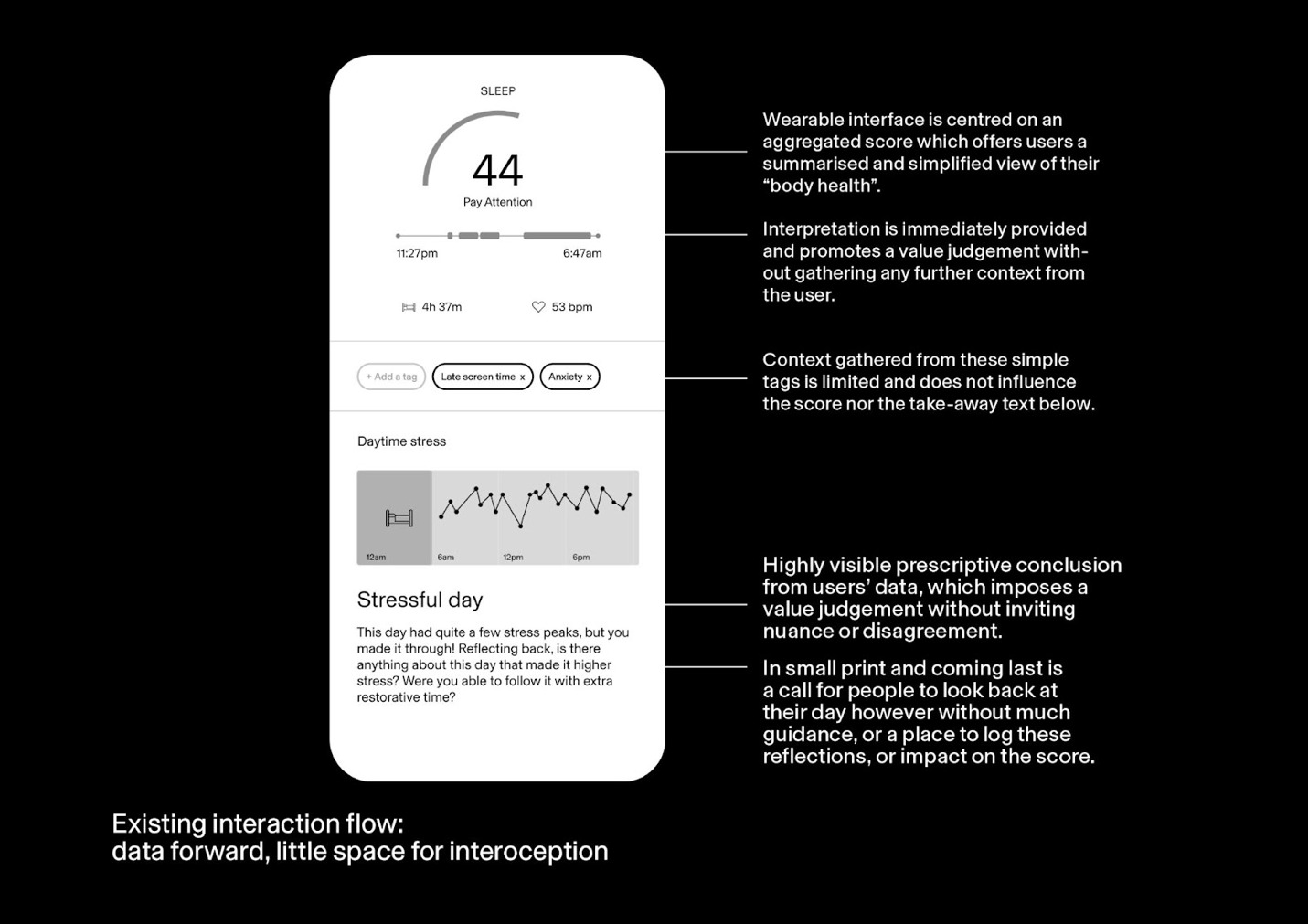
Most wearable interfaces today have a similar interaction flow and information hierarchy, centered around a CHS. The CHS and its accompanying text summary present a unidimensional conclusion derived from available biomarkers. Users are then quickly guided to an interpretation of that score, a summary takeaway, and suggested actions, leaving little room for embodied sense-making.
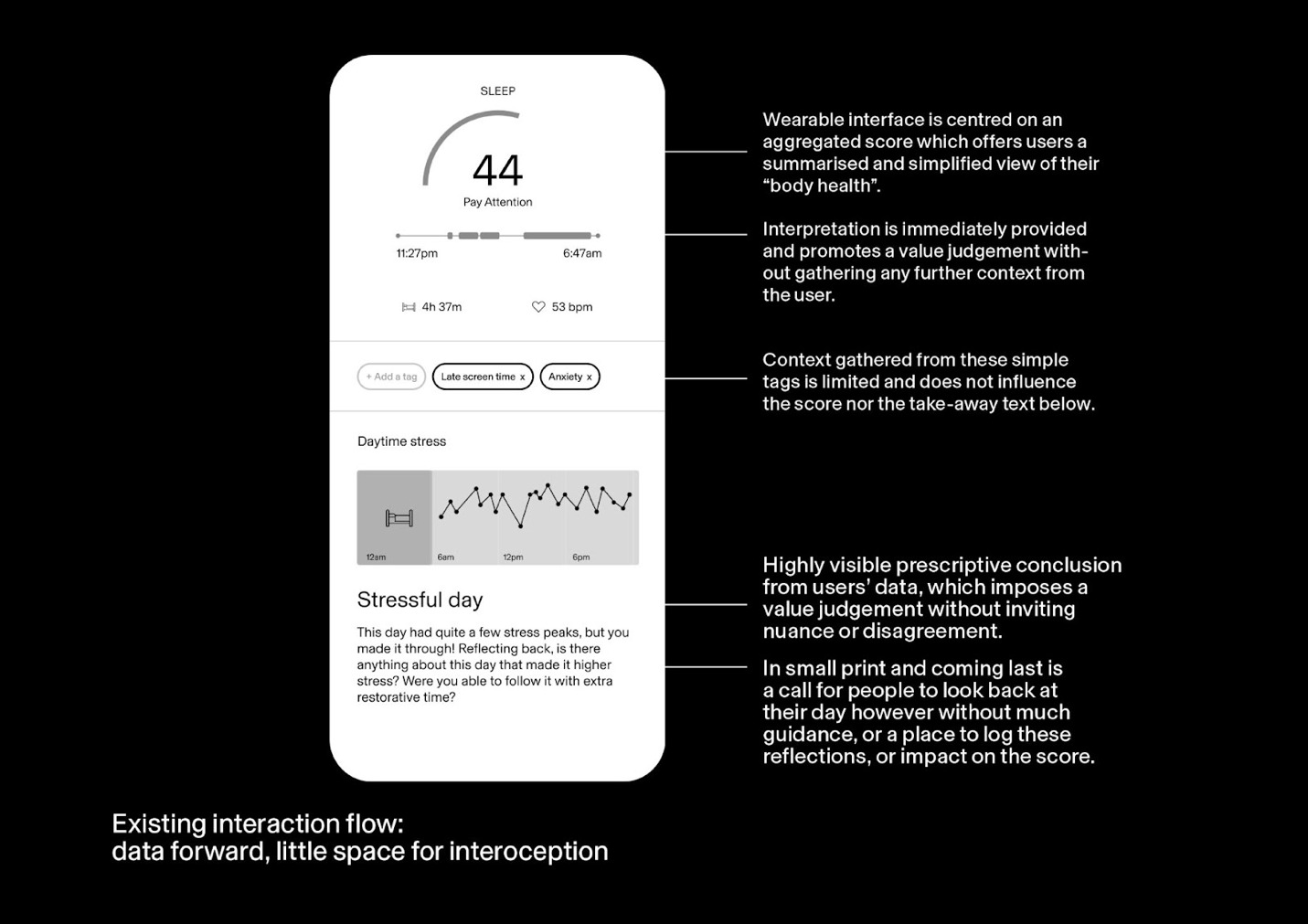
This design assumes the algorithm is accurate, without leaving room for users to contrast their data with their own sensations. Even brands that claim to ‘give the body a voice’ and reject performance-based narratives still offer limited prompts for self-reflection. Instead, they provide tagging features or conversational interfaces that allow users to add context to their scores—without encouraging them to turn inward or engage in a more active, interoceptive process. The result is a narrower dialogue, where users’ quantified selves are rarely in conversation with their lived, felt experience.
Take Oura’s “rest mode,” for example. This feature allows users to temporarily hide their scores when they’re feeling ill or exhausted, pausing activity tracking without affecting long-term metrics. While well-intentioned, it frames rest as an exception that is permissible only during acute disruptions like illness, injury, or jet lag (Oura Ring Support). In this paradigm, rest is not a regular or legitimate part of a user’s bodily rhythms, but a deviation from the norm of optimisation. The design logic unwittingly reinforces performance as a default orientation, subtly encouraging users to focus on maintaining ‘good scores’ rather than promoting attention and curiosity toward what their bodies might be communicating.
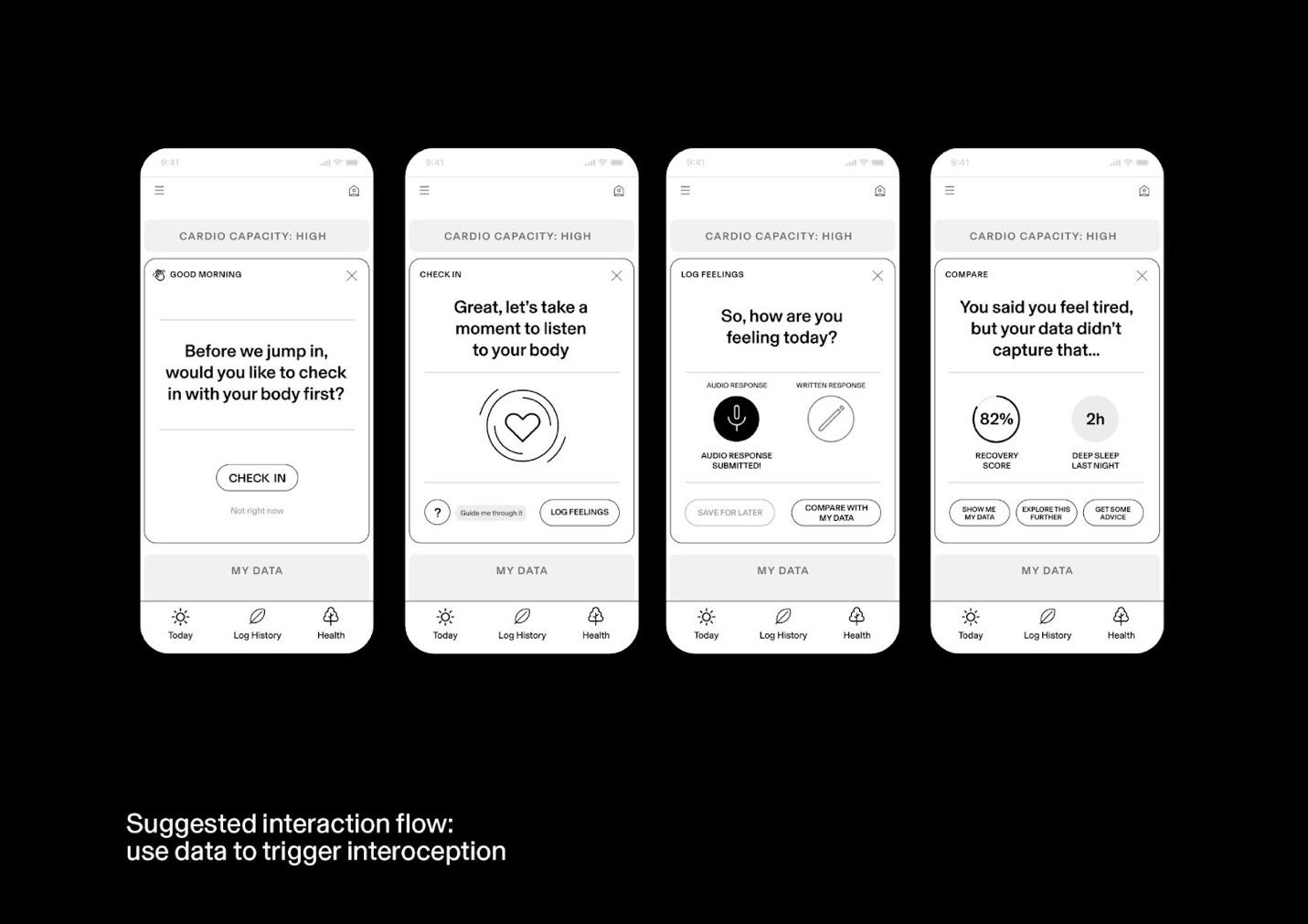
In addition to further refining data-first interaction flows, we suggest designing interfaces that begin with people’s felt sense before surfacing metrics. For example, a wearable could invite users to check in with their bodies before presenting a CHS. Visual cues might draw attention to the breath, supporting users in turning inward. Felt experiences could be recorded in audio or written form to create a qualitative log. This would not only support reflection, but also provide wearables with richer contextual data, improving the relevance and tone of recommendations. Over time, these qualitative entries could form a longitudinal record, offering users a way to revisit past experiences and reflect on what kinds of support have been most effective. Users could then choose to view their data and explore any tensions or alignments between metrics and lived experience.
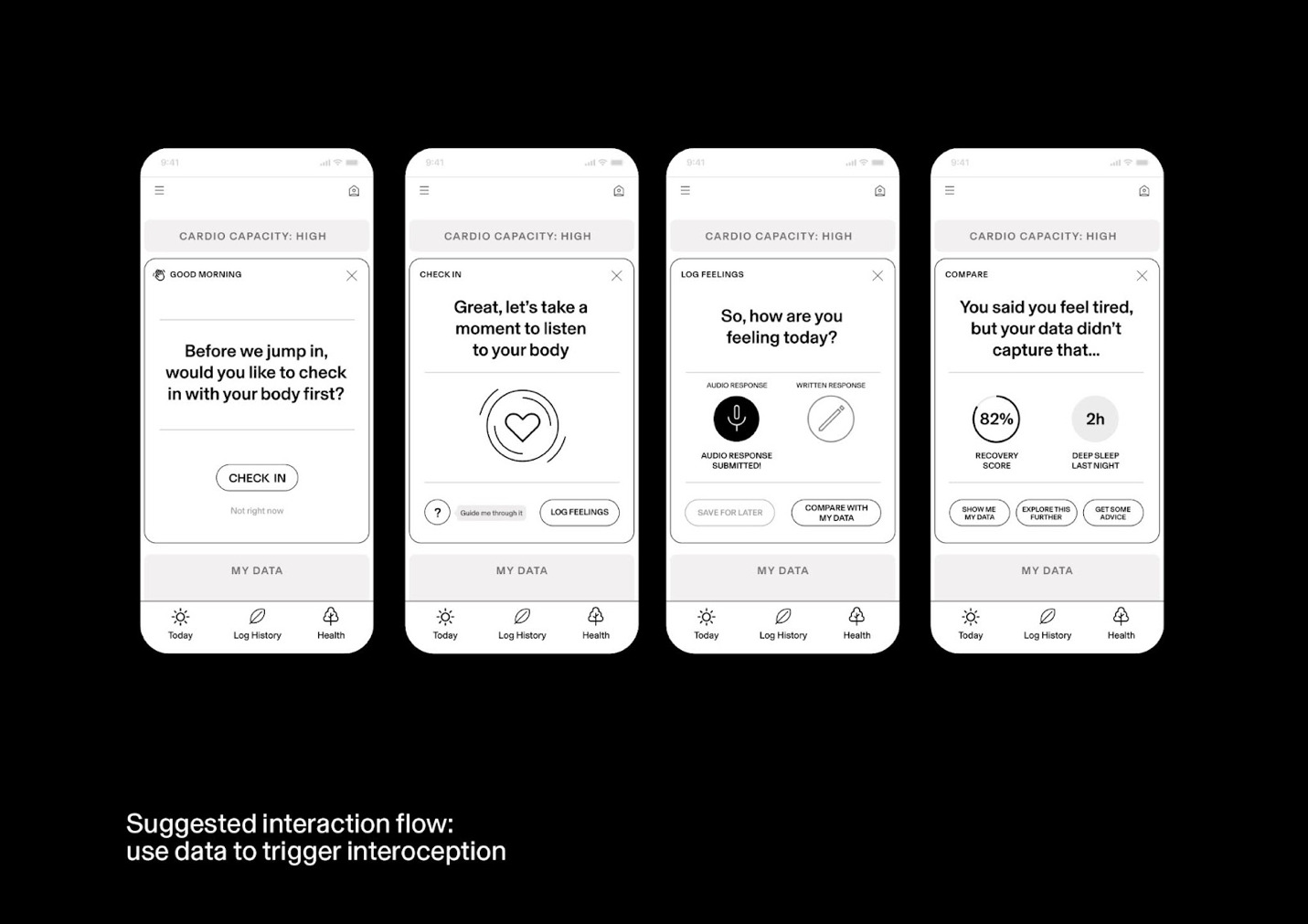
In doing so, wearable design moves closer to what Lupton (2014) describes as “reflexive self-monitoring” found in any form of self-directed inquiry (e.g. journaling), albeit with a closer attention to the body with the aid of somatic prompts.
How GenAI Could Support Interoception
Most companies position GenAI as an adjunctive ‘assistant’ or ‘advisor,’ often taking the form of a chat, with prompts directed toward exploring quantified data. For instance, Garmin’s Active Intelligence writes “the main components contributing to this score were sleep duration, REM duration, light duration, awake/restlessness and stress”—inadvertently prompting users to monitor their sleep data, not their actual sleep quality.
Even though our ethnographic exploration reveals that mismatches are frequent, GenAI is neither currently focused on bridging this gap nor inspiring people to engage with their bodily sensations. GenAI interactions often prioritize cognitive engagement by nudging users toward self-optimization through metrics, scores, and data-driven decisions. While this may offer some value, it reinforces a narrower bandwidth of relational possibility, where intelligence is framed as calculation rather than communion. What remains conspicuously absent is a deep invitation into somatic inquiry. GenAI could do more than coach performance; it could cultivate attunement to the body’s own wisdom, offering interactions that center somatic intelligence as a valid and vital source of knowing.
Rather than overwhelming users with a flood of data, GenAI could learn to surface pertinent information with parsimony—just enough to validate or gently challenge perception, without drowning out lived experience. This would allow users to remain anchored in their own sensory landscapes, attuned to subtle bodily cues and patterns. When metrics dominate, they can encourage mental interpretations of physical states, like seeing post-workout fatigue as a problem, while missing the nuanced sensations of muscle soreness and its shifting qualities.
Somatic practitioners remind us that we don’t always need to interpret sensations in order to tend to them. What often matters most is spending time with what’s felt by gently exploring its qualities to sense what kind of attention it’s asking for. While GenAI cannot replicate this embodied presence in the ways a practitioner can, it could still, for instance, offer prompts that guide users to notice their sensations by mapping their intensities along a gradient. In this way, the discomfort of intense exercise becomes something to explore, not something to fear.
As model capabilities expand, so does the temptation to have systems always ‘do more’ for users—in part to satisfy the value exchange of providing increasing amounts of biological data. If wearables were designed to support users’ somatic intelligence, they would prioritize doing more with rather than doing more for, shifting from simply delivering accurate data and personalized recommendations to co-creating experiences that build users’ skills, vocabulary, and confidence to navigate their bodies with greater agency. Future wearables could be designed to be somatic partners orchestrated by a conversational AI that is as empathic as it is curious, turning these devices from passive sensors and prescriptive advisors into tools that expand the range and depth of self-understanding.
Future Directions: Thinking beyond Conversational AI to Design with, not for the Body
Will I ever track again?
Yes, probably
For a specific goal or experiment
Or to observe a patternI’ll try to keep an objective, non-judging eye
But then I’ll stop
When I’ve seen what I needed to see
And learned what I wanted to learnLike any tool
Self-tracking can be used for benefit or harmI won’t let it
Be an instrument of self-torture
Any. More.– Alexandra Carmichael, Why I Stopped Tracking, 2010
Given the rapid normalisation of conversational interfaces as the default mode of interaction of LLMs, over indexing on this modality presents a risk for wearables seeking to move away from the cognitive realm and speak instead to users’ somatic intelligence. Presently, LLMs are designed to nudge certain types of conversations. For example, they are tuned to either end conversations earlier, by providing a definite answer, or keep them going, by asking follow-up questions. Knowing when to do each is an essential question for model designers. Our research suggests that often, users will find value in longer conversations that deepen inquiry more than attempt to resolve it.
The value users get from these interactions is not merely the answer to a specific question, but also the new questions brought forth during the conversation. A 2025 Harvard study revealed that “therapy and companionship” is the most common GenAI use case (Zao-Sanders 2025). This confirms the importance of dialogic interactions as key to unlocking value for users. Conversational UIs handle disambiguation and explanation well, yet they constrain interaction to high-attention, high-cognition moments.
Interaction designer Kristina Höök (2018) challenges the primacy of language as the default interface for design thinking precisely for this reason. “Designing with the body,” for Höök (2018), explores what becomes possible when we take somatic intelligence seriously. Moving away from language and symbols as starting points allows us to consider the body and its movement in space as an alternative foundation for interaction design. Wearable technology could aim to create sensory dialogue without numbers, moving closer to what somatic practitioners already offer. The materiality of wearables themselves (metals, plastics, woods) and their modalities (haptics, visuals, sounds) could be used as key features of interoceptive scaffolding as they each carry their own emotional resonance (coldness, warmth, neutrality) that influences how the body responds.
These qualities are not trivial design details, but core to how wearables shape bodily awareness. Unlike numbers, which pull attention outward into abstraction and comparison, sensory modalities invite users back into their own bodies. A vibration could guide the breath, a pulsing light could mirror a user’s experience of arousal, a tone could steady a user’s attention. In this way, wearables can speak a somatic language, creating dialogue that strengthens the interoceptive literacy of users by engaging them directly in their embodied experience.
Extending the sensing power of wearables beyond the body into its lived environment, as Ultrahuman proposes with their home sensor, adds another layer of context to understand how perceived levels of safety or threat determines the degree of nervous system regulation.
While the integration of the environment is still nascent, it stands to address a critical gap of wearable data that captures the physiological outputs of experiences while neglecting the contextual inputs that shape the body’s response.
As Carmichael reminds us in the final stanza of her poem—“I’ll try to keep an objective, non-judging eye / But then I’ll stop” knowing that “self-tracking can be used for benefit or harm”—the act of self-tracking can become a gesture of discernment rather than self-punishment. Carmichael’s closing intention mirrors our proposed orientation where somatic offloading is not merely a risk to be mitigated, but a conceptual bridge for reimagining how design might sustain our interoceptive capacities. As our ethnographic interviews attest, somatic offloading helps illuminate when and how bodily awareness is delegated to devices, inviting us to redirect that tendency toward features, interactions, and practices that enrich embodied sense-making. By recognizing when and how interoceptive processes are being delegated to devices, we can intentionally redirect this tendency toward features, interactions, and practices that sustain embodiment.
The future of wearable technology is wide open—especially when guided by GenAI’s potential to mediate a productive and protective dialogue between our qualified and quantified selves, while also reimagining wearables not just as interfaces, but as meeting places between our sensuous bodies and the wider world. The call of our paper is not to resist innovation of wearable technologies, rather to realign their orientation: offering solutions and sustained inquiry, scores and felt contact with sensations, optimising health performance and guiding gentle presence. In a world increasingly optimised, soma-centric design offers a quiet challenge—a return to the slow and sovereign intelligence of the body. Wearables, when guided by GenAI that supports the somatic intelligence of their users, can become more than sources of data-rich insight. They can become dialogic partners in the daily unfolding of our lives and the messiness that makes us human.
About the Authors
Indigo Weller is a senior consultant and narrative researcher with a background in patient advocacy and medical education. Prior to joining Stripe Partners, he served as a development editor for patients writing illness memoirs and legacy projects. He is a facilitator for the European Reminiscence Network, an international dementia arts initiative, and holds degrees in Bioethics, Narrative Medicine, and Creative Writing.
Noémi Cassin is a medical anthropologist and consultant at Stripe Partners. Her research interests centre primarily on the body and explore ideas of agency and phenomenology in the context of chronic health conditions and non-biomedical health practices. She holds an MSc in Biosocial Medical Anthropology and a BSc in Human Sciences from University College London.
Cyril Maury is a Partner at Stripe Partners, where he leads the company’s healthcare practice. A seasoned strategy and innovation practitioner, his expertise centres on helping companies develop new business models to unlock growth opportunities. Having lived in Latin America, the Middle East and Europe, he particularly enjoys untangling the operational, organisational and cultural complexities inherent in expansion in emerging markets. Prior to joining Stripe Partners, Cyril spent most of his career in strategy consulting. He is an HEC Paris and Sciences Po graduate.
Research Ethics
Participants were recruited through snowball sampling methods, using word of mouth and posts on social media and relevant networks. All participants agreed to share their experiences with wearables and show us some of their data. Informed consent was obtained ahead of interviews. 60-minute interviews were held on Google Meet and recorded. Given the potentially sensitive nature of the topics discussed, all participants were offered the right to withdraw or skip questions throughout the interview. Transcripts were generated and pseudonymised through the software Grain and kept privy to the research team. Pseudonymised transcripts were uploaded to NotebookLM to help extract themes and key quotes. Participants were compensated for their time and the knowledge they shared with us. Wearable data was not collected. Participants were informed that recorded transcripts and screenshots will be deleted in 12 months, as per Stripe Partner’s internal consent policy.
Generative AI Disclosure
A preliminary literature review was conducted using the enterprise version of Google’s Gemini Deep Research to identify academic articles. NotebookLM was used for extracting quotes and identifying themes across interviews to inform analysis. Once the draft was completed by all authors, Google Gemini was used for reducing the length of the paper to adhere to EPIC’s publication requirements and ensure consistency of style and syntax for readability.