Session Report
The Ecological Intelligences Salon explored how artistic work can speak to the idea that, basically, human life is now a ‘more-than-human’ condition. We had a particular focus on the installations of IC-98, the artistic duo Patrik Söderlund and Visa Suonpää (portfolio: https://socialtoolbox.com/files/IC-98lores.pdf). After considering what ‘ecological thinking’ might mean, we examined specific artistic interventions and tried to deploy them.
The event was initially pitched as a round table with Patrik, after the exploration of IC-98’s work. Since Patrik unfortunately could not make it, artist and designer Meghan McGrath shared her ‘more than human’ cards and art as a provocation for discussion.
We do not think ‘about’ ecology the way we used to. Instead, ecology has become more like a way of thinking itself, a paradigm or a perspective, and artists such as IC-98 have been at the heart of this transposition. Ecological thinking recognises that life itself, and intelligence, are by nature distributed, because different entities and beings must be mutually dependent. Without ecology, a person could think ‘about’ the forest, but the ecological person must exist within the network of many forest species, and therefore thinks ‘with’ them. Such more-than-human intelligences reveal how the scales of human existence become more variable: humans now become used to seeing the world at many scales, experiencing being as large as a planet when we see the Earth, and experiencing existence on a nanoscale when we witness atoms. It also means that there is a fundamental experience of other intelligences in any ecological thinking act, indeed that encountering alterity, the unfamiliar and the uncanny, can be productive.
The art installations of IC-98 synthesise what ecological thinking may involve, and in doing so, try to make it something we can witness, experience, contemplate, and use. In the salon we examined especially the works A View from the Other Side (2011), House of Khronos (2016), and Realms (2018). Of especial interest to us were the ways in which these works seemed to disrupt time and temporalities. Ten seconds of watching one of the videos might imply that ten seconds has actually passed in the world of the artwork, or at times it could be years, as events transformed. This makes time a very sensory experience for the audience, disrupting time and temporality in potentially productive ways and leaving a lasting impression on the viewer. Rather than being convinced that we exist within a grand structure of space and space, which is rational and evenly structured, we were left with the impression of encountering time as something beyond us, almost like a mutable thing or a substance.
The work of undoing or loosening our assumptions through art also extended into social politics. In the work House of Khronos, IC-98 have set aside a house as the residence of ‘Time’ himself (Khronos). The house and grounds will be left to gradually decay, and cannot be visited, but can be witnessed through an app. In this act of cosmological and social inversion, art enables many political conventions to be unpacked. For a normal house in Finland, there would be a pressure to repair and keep up the property. Neighbours or councils would complain about neglect and decay, pushing owners into constant acts of building and repair. Sitting outside of this political order, the work represents a kind of act of social and political undoing. The dominant social compulsion towards human shaping of the world, which has resulted in an anthroposcenic world, is placed on hold in this work, and revealed as something built into the social order and legitimised by prevalent attitudes to material stuff, such as concrete, roofs, trees and grass.
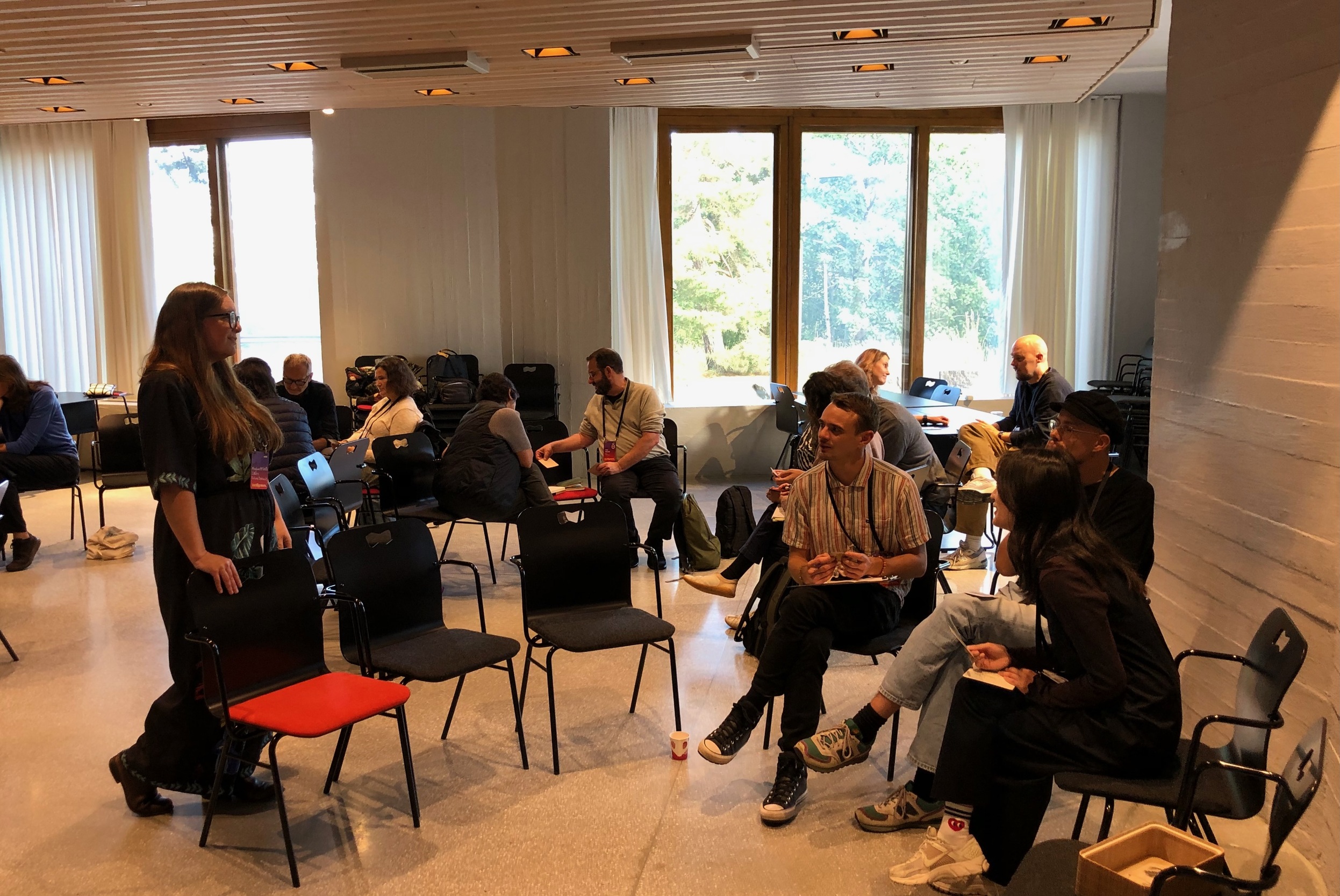
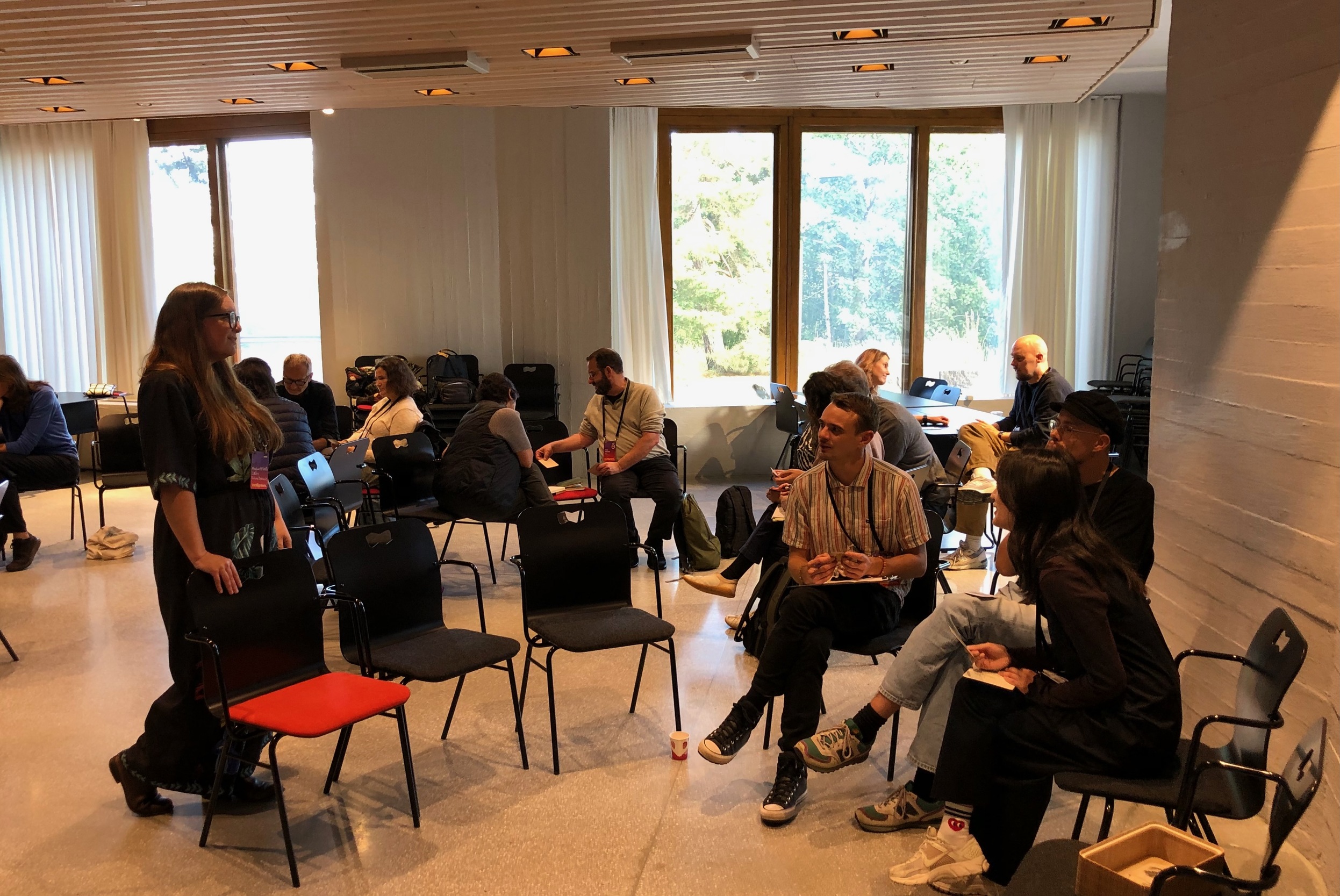
In the second part of the Salon, we extended these observations and experimented to see how members of the EPIC community might use art within their own professional work. We introduced and worked with Meghan McGrath’s More Than Human Cards as a potential way to disrupt our assumptions and think differently. Each of the cards in this set presents a different entity. Many of these are species, but others are materials (‘Tantulum’), communities (‘Termite Mounds’) or things on radically different scales (such as planets). The entity on each card was chosen and researched so as to produce a considered set of possible perspectives radically different from the human. Each card contains a description explaining how it manifests a different life, or perspective on living - different timescales, rhythms, scales, priorities, ecological positions, and so forth. In the salon, we used these cards to re-think our situation within the building where EPIC 25 was taking place, Dipoli. Dipoli was partly conceptualised by its architects (Raila and Reimi Pietilä) as resonating with its environment, among other things being based on the undulating bedrock itself rather than on even concrete foundations. But it was also designed and built for humans. Picking a card, we each thought about the building from the perspective of a different, non-human entity. We aimed to explore this building thinking ecologically and by inter-species intelligences, as fruit flies, as predators, as trees, and as minerals.
Interestingly, it worked. Conversation flowed. We raised a multitude of ideas, we talked. Our time was limited, but we could have talked for much longer. It was clear that in different ways, designers, strategists and researchers could use these kinds of techniques. The presentation of such exercises would be key for many EPIC professionals: the places where we work have become if anything in recent years more serious and more ‘data-driven’, so the game-like presentation of ecological thinking needs to be pitched right. But it can work.
What the Salon did was unpack one set of approaches to the current problematics emerging around intelligence and of experience, because of the range of current technologies and data processes understood to be Artificial Intelligence. What many participants understood was that we are not only dealing with what AI is, or how to use these ‘tools’; but with social and work situations in which people feel very differently about themselves and the work they do. In many environments, new ways of thinking seem to be happening to us, rather than being used by us. The notion of ecological intelligences (alterity, distribution, scalarity, temporality), accessed through art, proved to be one way to gain a grip on what the key questions actually are which we can produce and ask.