Session Report
The “Crafting Ethnography” salon included two full-capacity events in which dozens of EPIC community members articulated their perspectives on the craft of ethnography, as well as the many obstacles we face in maintaining and evolving our craft.
On the surface of things, craft involves embodied skills developed over time, typically referring to things “handmade” (see Atkinson 2013). Carpentry or bookbinding might be classic examples. Craft is also found more broadly in those things made in traditional or non-mechanized ways, by an individual or small group of humans who pass on skills across generations. For most Salon participants, ideal ethnographic craftwork is valuable, meaningful, and ethically produced.
But we harbor few illusions about the constraints of our craft. In the marketplace today, there is a desire for mass craft or craft-at-scale. Similar mass craft brands and producers seek ways to automate craftwork, hitting some sweet spot that preserves the meaningfulness of handcrafted things at a price point that allows for market growth. This is perhaps where our own ethnographic work is situated these days. We are not purist craftspeople, rather we situate our craft between forces of mass production and craft production, always striving for high quality work.
Simon Roberts, board president at EPIC and co-founder of Stripe Partners, in a recent podcast interview with Peter Spear (Spear and Roberts 2025), has said that researchers like the ones assembled at our Salon are “craftspeople at heart…We’d rather look at the world through a project than a spreadsheet.” And Peter Spear, himself a professional ethnographer, responds that there are a number of forces that “squeeze craft out of research…[we] get flattened by the machine of mediocrity.” So, we asked Salon participants:
What are your obstacles that ‘squeeze’ craft out of research these days? And inversely, what strategies or tactics create space for the craft?
Participants talked about a wide range of obstacles and forces of mediocrity, including paradigms of efficiency in the business world, abbreviated timelines, and lack of prioritization for our types of research. Organizations that don’t quite understand ethnography or its value generate resistance. Meanwhile, a trend of democratization of research has perhaps expanded opportunities for qualitative research in some ways, but at the expense of the craft and quality of the research.
Participants also discussed the crafty ways in which they create opportunities for ethnography by embracing unfamiliar territories. In essence, ethnographers develop their most effective pathways by first turning their research and analytic lens on the organization and marketplace to understand the context in which they operate. They’re working within constraints and appropriating the languages of business, storytelling, or design to make their case.
Many of these forces and opportunities have been shaping the craft for many years. And Salon participants enjoyed a cheerfully heated debate in our second session around whether ethnography had introduced anything new or novel over the last century (a comment met with audible groans and countless retorts!).
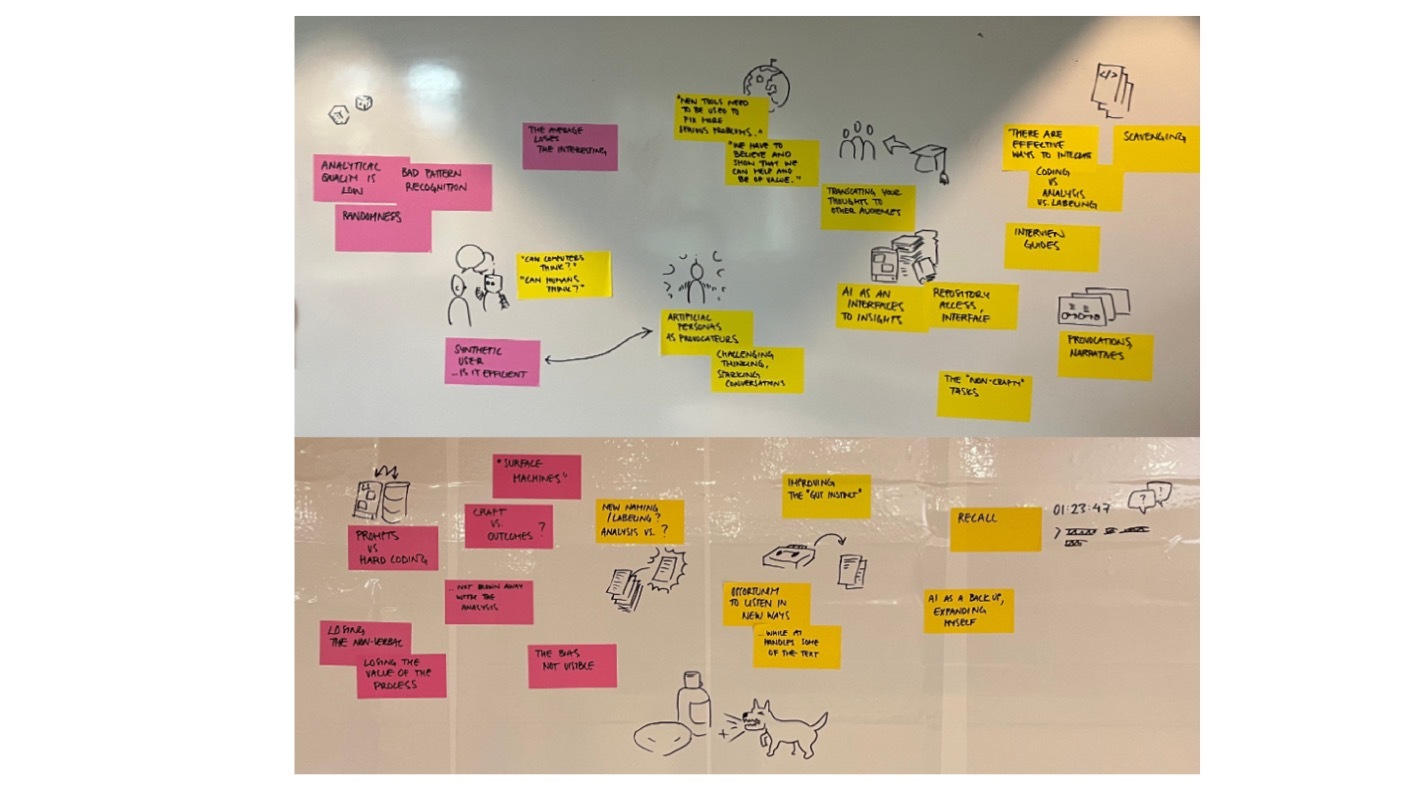
A new conversation in the Salon, building on paper presentations and so much corridor talk throughout the conference, revolved around the role AI has played or might play in ethnographic research projects. Anticipating this concern, the second provocation for Salon participants invited both optimism and pessimism. We asked a two-part question:
First, what are some novel or emerging criticisms of AI that we need to look out for and that might impact our craft? What is perhaps not yet being addressed? And second, what are some potential benefits or blessings of these new AI tools? How might they help us develop our craft, potentially in novel ways?
Much of what the EPIC community finds objectionable about AI is an expanded and accelerated version of that “machine of mediocrity” described by Spear and others. AI will yield research results faster and cheaper, but will ultimately sacrifice the craft in some ways. AI will democratize research in some ways, but at the cost of quality. Organizational stakeholders may not recognize what’s lost.
What this conversation brought to light, however, might be called the resilience of the ethnographer’s craft. Our contextual awareness, combined with the challenging situations in which we find ourselves, helps focus ethnographers on the problems at hand. In organizational settings, that can lead to creative solutions for relationship-building to enable access or for embedding and growing stakeholder buy-in.
Ethnographers don’t see the craft as failing them, and there are few elements of the craft they want to let go. Rather, it’s the framing and the context in which they work the craft that matters. At this moment, ethnographers seek ways to “hack” AI tools for their own purposes. This might yield more efficient workflows or broadening the scope of research. In other words, ethnographers are cautiously optimistic about integrating AI tools in their craft. That said, any integration may exacerbate internal tensions within ethnographic craft, especially around issues of scale and research design. That’s perhaps a conversation for a future Salon.
Salon Group Work and Discussion Documentation
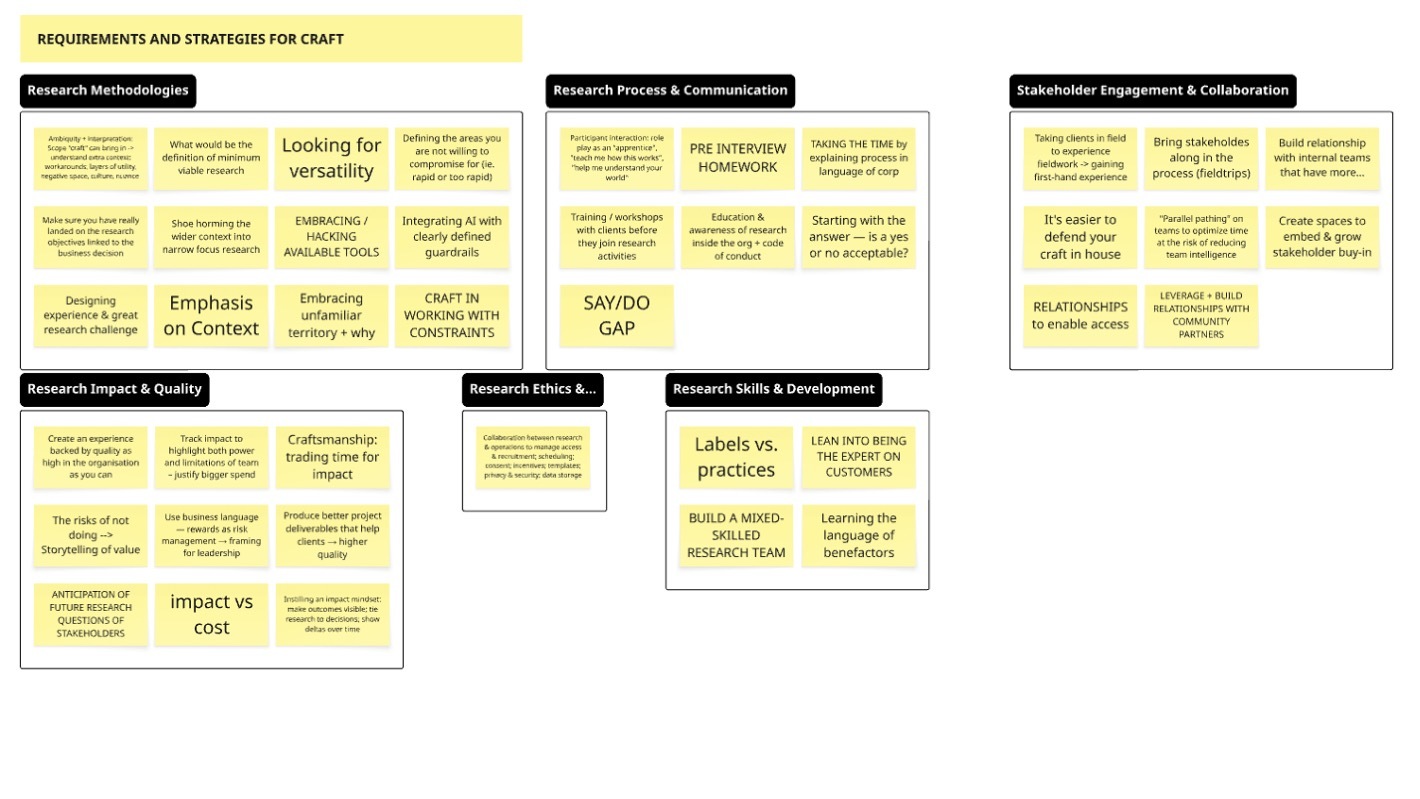
Requirements and Strategies for Craft
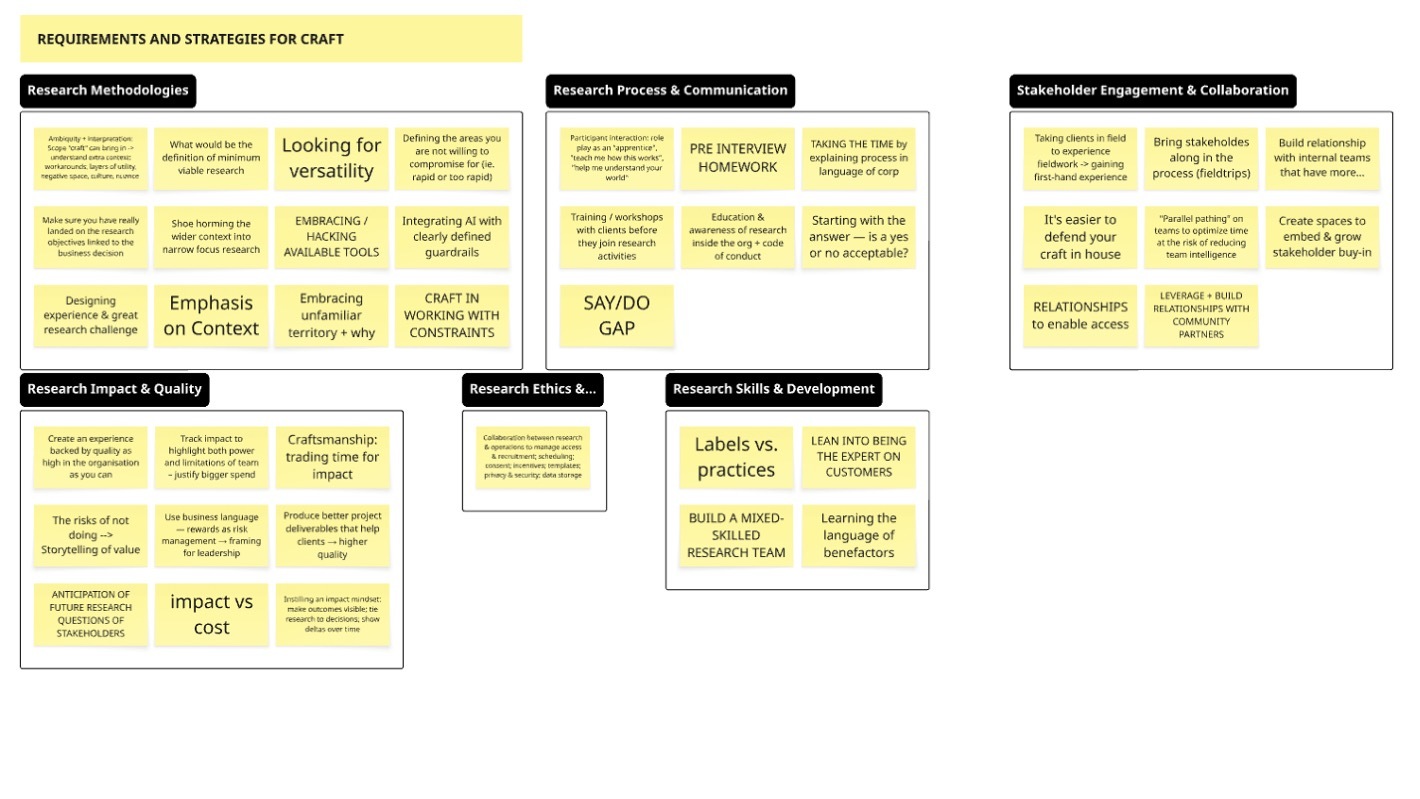
Research Methodologies
-
Ambiguity + interpretation: scope “craft” can bring in → understand extra context: workarounds, layers of utility, negative space, culture, nuance
-
What would be the definition of minimum viable research
-
Looking for versatility
-
Defining the areas you are not willing to compromise for (i.e. rapid or too rapid)
-
Make sure you have really landed on the research objectives linked to the business decision
-
Shoe horning the wider context into narrow focus research
-
Embracing / hacking available tools
-
Integrating AI with clearly defined guardrails
-
Designing experience & great research challenge
-
Emphasis on Context
-
Embracing unfamiliar territory + why
-
Craft in working with constraints
Research Skills & Development
-
Labels vs. practices
-
Lean into being the expert on customers
-
Build a mixed-skilled research team
-
Learning the language of benefactors
Research Impact & Quality
-
Create an experience backed by quality as high in the organisation as you can
-
Track impact to highlight both power and limitations of team – justify bigger spend
-
Craftsmanship: trading time for impact
-
The risks of not doing → Storytelling of value
-
Use business language – rewards as risk management → framing for leadership
-
Produce better project deliverables that help clients → higher quality
-
Anticipation of future research questions of stakeholders
-
Impact vs cost
-
Instilling an impact mindset: make outcomes visible; tie research to decisions; show deltas over time
Stakeholder Engagement & Collaboration
-
Taking clients in field to experience fieldwork -> gaining first-hand experience
-
Bring stakeholders along in the process (fieldtrips)
-
Build relationship with internal teams that have more…
-
It’s easier to defend your craft in house
-
“Parallel pathing” on teams to optimize time at the risk of reducing team intelligence
-
Create spaces to embed & grow stakeholder buy-in
-
Relationships to enable access
-
Leverage + build relationships with community partners
Research Process & Communication
-
Participant interaction: role play as an “apprentice”, “teach me how this works”, “help me understand your world”
-
Pre-interview homework
-
Taking the time by explaining process in language of corp
-
Training / workshops with clients before they join research activities
-
Education & awareness of research inside the org + code of conduct
-
Starting with the answer — is a yes or no acceptable?
-
Say/do gap
Research Ethics & Compliance
Collaboration between research & operations to manage access & recruitment; scheduling; consent; incentives; templates; privacy & security; data storage
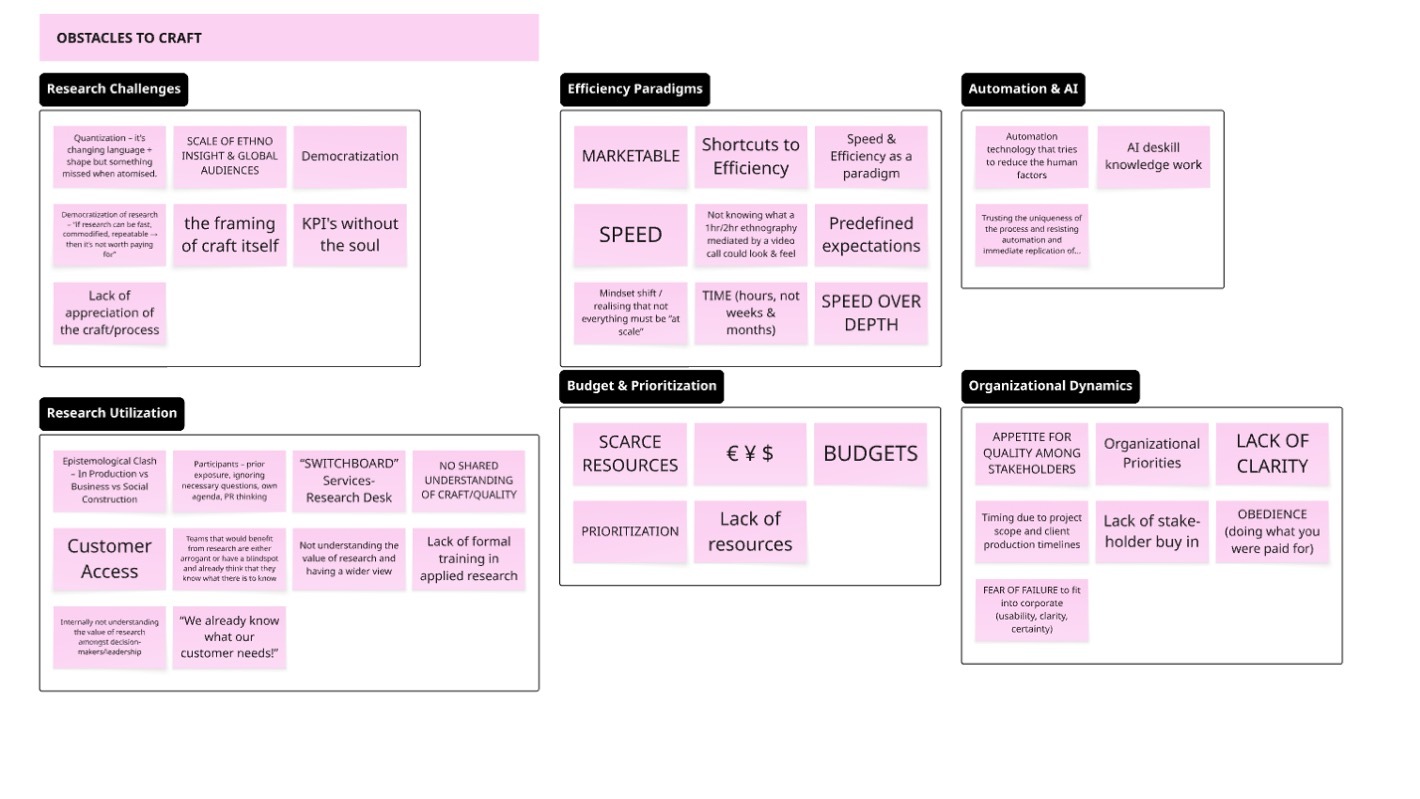
Obstacles to Craft
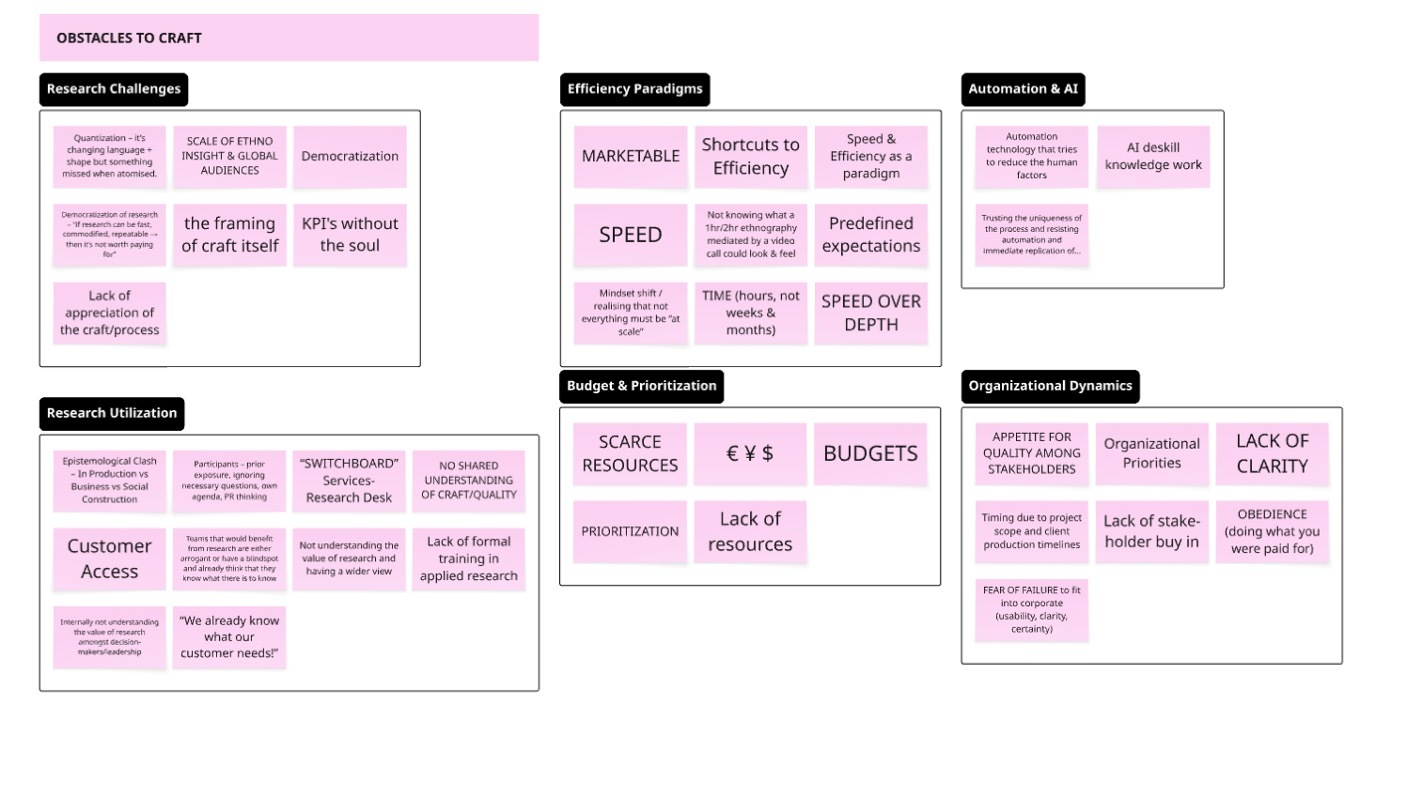
Automation & AI
-
Automation technology that tries to reduce the human factors
-
AI deskill knowledge work
-
Trusting the uniqueness of the process and resisting automation and immediate replication of…
Research Challenges
-
Quantization – it’s changing language + shape but something missed when atomised.
-
Scale of ethno insight and global audiences
-
Democratization
-
Democratization of research – “if research can be fast, commodified, repeatable → then it’s not worth paying for”
-
the framing of craft itself
-
KPI’s without the soul
-
Lack of appreciation of the craft/process
Research Utilization
-
Epistemological clash – in production vs business vs social construction
-
Participants – prior exposure, ignoring necessary questions, own agenda, PR thinking
-
“Switchboard” services-research desk
-
No shared understanding of craft/quality
-
Customer access
-
Teams that would benefit from research are either arrogant or have a blind spot and already think that they know what there is to know
-
Not understanding the value of research and having a wider view
-
Lack of formal training in applied research
-
Internally not understanding the value of research amongst decision-makers/leadership
-
“We already know what our customer needs!”
Efficiency Paradigms
-
Marketable
-
Shortcuts to efficiency
-
Speed & efficiency as a paradigm
-
Speed
-
Not knowing what a 1hr/2hr ethnography mediated by a video call could look and feel like
-
Predefined expectations
-
Mindset shift / realising that not everything must be “at scale”
-
Time (hours, not weeks & months)
-
Speed over depth
Budget & Prioritization
-
Scarce resources
-
€ ¥ $
-
Budgets
-
Prioritization
-
Lack of resources
Organizational Dynamics
-
Appetite for quality among stakeholders
-
Organizational priorities
-
Lack of clarity
-
Timing due to project scope and client production timelines
-
Lack of stakeholder buy in
-
Obedience (doing what you were paid for)
-
Fear of failure to fit into corporate (usability, clarity, certainty)